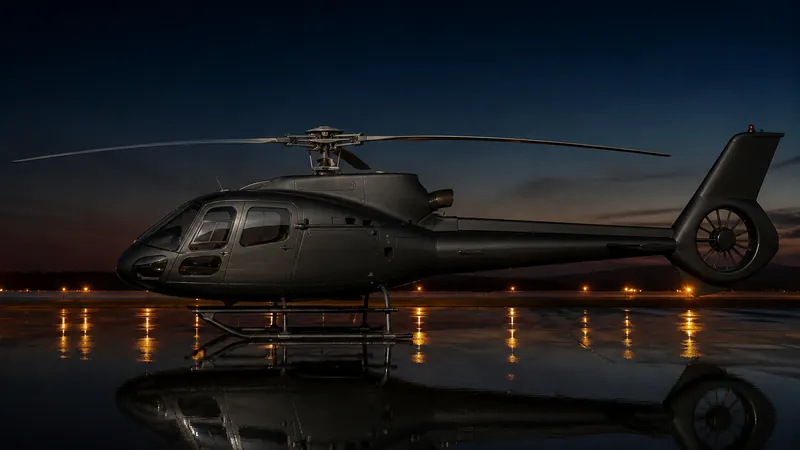
The H125 at altitude: what it does well and where it runs out of room
The H125 is Airbus's current name for the AS350 B3e Écureuil, a single-engine type long used for mountain work. One Safran Arriel 2D turbine of 952 shp drives it, managed by a dual-channel FADEC engine control.
Its numbers are built for height rather than cabin space. Airbus gives a hover ceiling out of ground effect of 3,871 m and a maximum operating altitude of 7,010 m. In 2005 an AS350 B3 landed and took off from the summit of Everest, at 8,848 m, a world record Airbus still cites.
What that means on our Alpine routes
Courchevel altiport sits at 2,008 m and the Verbier helipad at about 1,500 m. Both are far inside the H125's hover margin, which leaves power in hand for the landing. That is why it is a natural fit for Geneva to Courchevel and Geneva to Verbier.
Airbus quotes a fast cruise of 136 kt and a range of 340 nm at maximum take-off weight. Endurance is about four and a half hours. Each Alpine leg uses only a fraction of that, so on a cold day the operator can trade fuel for passengers and skis.
The cabin, plainly
Airbus certifies it for one pilot and up to six passengers, or two pilots and four. Charter operators usually plan for five, as on our spec strip. The passenger cabin is 3.0 m³, smaller than the H130's 3.7 m³, so weight and bag count matter more here than on the twins.
We pass passenger and luggage weights to the operator before the day. For a family with a fortnight's ski kit, that can mean a second rotation or a step up to a larger machine.
When to choose something else
For a coastal hop where the view and cabin matter more than altitude, the H130 uses the same engine with a wider cabin. For six to eight passengers, or two engines over the mountains, the H145 is the step up. The H125 remains the sensible, light answer for two to five people with sensible luggage.